American Princes - II: The Prince at the Convenience Store
I had no idea as I set out from Hells Gate State Park on the Idaho side of the Snake River on Day 12 that I would meet a prince later that afternoon. My ride that day from the river up to the Camas Prairie was one of the most memorable rides of the trek, unforgettable partly for the Taoist breakthrough I recounted in my July 13 post, Resolving the Bike Trip of the Mind vs. The Bike Trip of the Body. My conversation with a young horse a few miles into the ride also made it noteworthy (but that’s another story altogether). I also think the ride has been indelibly etched in my mind because of the spectacularly scenic and challenging route I followed. The effort began as soon as I left the Snake River valley: I had to stand on the pedals and grunt my way up a short but leg-shredding ascent onto the flat, Palouse Plateau.
Biking on the plateau, with the hazy blue-green panorama surrounding me, was like riding over a tabletop suspended in the sky. I pedaled slowly between barren and planted fields of wheat and lentils, around a man-made lake, until I came to the eastern edge of the plateau. Below me I spied the chewed-up asphalt winding through wheat clinging to the steep hillside that would take me down to the 2-lane highway below. As I began my rolling plunge, the valley raced up to meet me.
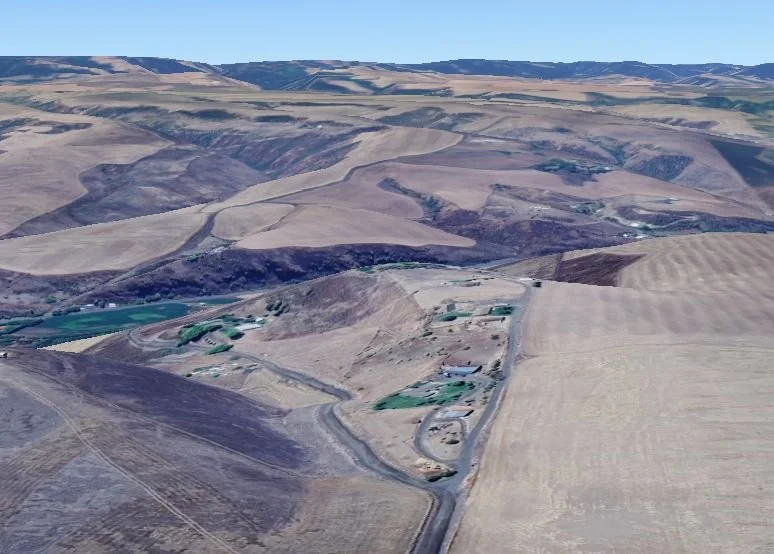
Google Earth image of the southeastern edge of the Palouse Plateau.
Once on the narrow valley floor, I began the 19-mile unnamed climb alongside Lapwai creek to the Camas Prairie, named for the blue-flowering camas, an important food source for Indigenous tribes. As the miles passed, the canyon walls narrowed and soon I was working up steep, curving ramps, the bare hills now resplendent with conifers climbing up the canyon walls. Under clear blue skies, I felt I had been ushered through the glimmering gates of bike trek heaven.
As is The Way, there is always a little hell in heaven, and my body soon melted in the scorching heat, suffering in the middle of the afternoon during a record-setting week of high temperatures. The previous week I had climbed for 30 miles up to Snoqualmie Pass in the Cascades, but that was on a gentle rail-trail under cloudy skies on a cool, moist day. But here I was, like a mad dog and Englishman, climbing under a cruel sun, resisting my body’s screaming urge to give up. Fortunately, I could stop every few miles, scramble down a shallow embankment and dip my head in the clear, icy cool waters of Lapwai Creek.
It was past mid-afternoon when the canyon walls receded, and the road finally leveled off. Less than a mile later, I pulled into a gas station convenience store lot, my ego inflated with pride, for I had just gone mano a mano with one mother of a climb, and I had emerged victorious. My self-worth was further stroked when later, sitting on a bench outside the store and rehydrating, a man got out of his car, took a look at me, then glanced at my bike, and asked in wonder, “Did you just summit that climb?”
But first, I went inside the store to buy water. I was so self-absorbed with my swollen sense of achievement that when I took two half-gallon jugs of water to the check-out counter, I was unprepared for who I saw behind the register.
A Nez Perce prince.

The Nez Perce Indians have lived in what is now eastern Washington and western Idaho for thousands of years. They refer to themselves as Nimíipuu , which translates as “We, The People” (rendering the opening words of the U.S. Constitution’s Preamble as somewhat less than original.)
The Nez Perce belong to a loosely associated group of tribes called “Plateau Indians” because they inhabit the inland portions of the basins of the Columbia and Fraser Rivers in British Columbia and the northwest United States. The Encyclopedia Brittanica states that they were the dominant people in the Columbia Plateau going back 11,500 years, especially after acquiring horses and breeding what is known as the Appaloosa. Nez Perce (“pierced nose”) is the name the French-Canadian fur traders gave them. Neither exclusively hunters nor gatherers, they harvested root plants in early spring, trapped salmon in the summers, and traveled to the high country to hunt deer and elk in the fall while those who remained at home harvested berries.
Like many Indigenous cultures across North America, their governance was non-hierarchical, and consensus based. Ethnographic sources refer to leadership in the Nez Perce culture as “earned and situational” where power derived from the people. While we can only aspire to live in a country that truly embodies “We the People,” the Nez Perce lived by that principle for centuries before there was an America.
Under severe pressure from White settlers (backed by natural resource-hungry capital), and after already signing a treaty in 1855 where they ceded portions of their territory, the Nez Perce split into two groups: those bands who signed the Walla Walla Treaty of 1863 and reduced the size of their reservation by 90% and those, led by Chief Joseph’s Wallowa Band, who refused. The Nez Perce War of 1877 erupted after gold was discovered on their remaining lands and U.S. forces attempted to forcibly relocate the non-treaty bands. As I see it, the Nez Perce’s military resistance was in defense of their decentralized autonomy, their desire for self-rule. In this light, the Nimíipuu had much in common with colonists during the American Revolution. The key difference, however, was that the Nez Perce were fighting for a decentralized way of life while the colonists were defending a highly centralized autonomy.
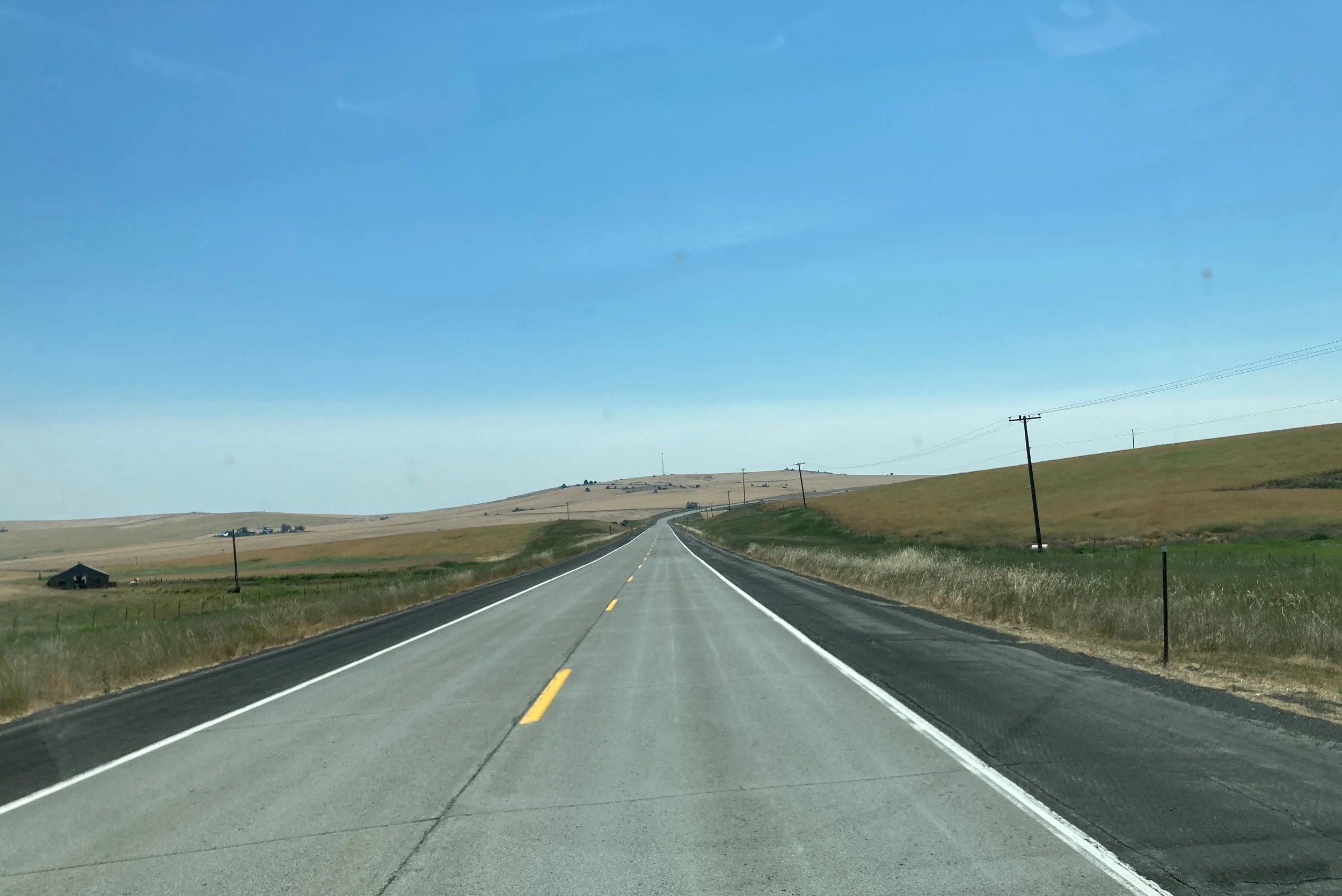
US 95 running through the Camas Prairie in Idaho.
Four days before I stepped into that convenience store we had slept in the Prince of Bentonville’s parking lot outside of his Walmart palace of commerce. Now, in this micro-Walmart, on the other side of the counter where I placed the containers of water, stood a different sort of prince: a tall young man, about six feet-five with long black hair. He had a striking face, possessed with quiet dignity and decency. He seemed to radiate an aura of humble confidence.
I didn’t know what to expect when he spoke, but it surely wasn’t that he would sound like any other young anywhere-in-America convenience store clerk.
“Anything else for you, dude?” he asked.
I shook my head, feeling small.
I knew I was not looking at a literal prince; the Nez Perce would scoff at the very concept of a noble class. Nonetheless, there was a princely quality about him. I have given a lot of thought to that young man and his people, especially after reading Selling Your Father’s Bones, a well-researched and poignant telling by the British author Brian Schofield of Nez Perce survival of the 140-year military and cultural war waged against them.
In our capitalist culture, Sam Walton’s achievements are lauded and worthy of praise. But a good portion of Walton’s success was predicated on the exhaustion of natural resources, smothering competition, and downward pressure on wages. It’s revealing that these harmful attributes are not generally held against him. Compared to how Walton earned his princely status with how Nimiipuu princes – the tribal bands’ leaders –earned theirs (through deeds that benefit the larger tribal unit), I would much rather live under Nez Perce societal rules.
I wonder what the prince in the convenience store thinks about the world he grew up in and if he’s angry or sees any reason for hope. For me, I hold out for the day when the young Nez Perce prince I saw – and all his brothers and sisters – are able to strike a balance and live fully in two worlds, the white, western world imposed on his people and the traditional world of his ancestors. Where the younger generation, as they are doing now, learn to speak the nimipuutímt* language, lace up their buckskin to dance the ceremonies, and regularly cleanse themselves in sweat lodges.
* link to a video of the Nez Perce Language Program

Shannon Wheeler, Chairman of the Nez Perce Tribal Executive Committee
If we ever write the chapter in America’s story where we have dialogues of reconciliation with Indigenous tribes (and the descendants of slaves), it would be fitting if Indigenous voices – those with feet firmly planted in both traditional and western worlds - could finally be heard instead of being marginalized as they are now. Perhaps some Nez Perce prince might be able to help stitch together our social and economic fabric and maybe, just maybe, lead all of us – white, black, brown, and copper - to learn how to do without doing.