Why the Dreamland State?
Who can withstand the tension when caught between the pull of the status quo and the demanding forces of change?
Why Dreamland?
In my last post I recalled how watching an aggressive stream of television commercials one evening at a weary Ramada Inn in Xenia (Ohio) sparked the idea that Americans live in a dream-like state. In the post, I concluded that our ability to think critically is no match against the flood of illusions marketed to us by political and economic actors.
Up until that evening, on the ride I sensed there was a dreamlike character to our country, perhaps from seeing so many people buying into the sugar-frosted version of American history and accepting the fiction that we can consume our way to happiness. But if you had asked me the reason for this Dreamland state, I wouldn’t have been able to give you a clear answer.
In the interim, I’ve had ample time to ponder why this state exists, and my hypothesis is that humanity has an innate aversion to uncertainty and ambiguity. Bear with me as I provide a somewhat circuitous explanation for how an aversion to vagueness helps bring about this Dreamland state.
Short Explanation: Complimentary Opposites
My premise is based on a synthesis of eastern philosophy (particularly Taoism), Jungian theory, quantum physics, and something called the Electric Universe Theory. The first three poetically converge on the concept of complementarity — the tension that inherently exists in between complementary opposites — and our relationship with these naturally occurring and human-made binaries.
I’m convinced that complementary opposites unsettle us to the point where we are unable to understand and act upon the possibility that two opposite ideas or behaviors can exist (and therefore may both be true) at the same time. Our discomfort with this tension causes us to accept stories (i.e., ideologies and beliefs) that are more aligned with our preexisting viewpoints and opinions.
Long Explanation: Taoism, Jungian Theory, Quantum Physics, EUT and Nuance
One of the themes in my book is the underlying tension in life between complementary opposites. Early in the book I use the “honey-onion experience” metaphor as an example: each day we experience both the sweet and bitter (a theme expanded upon in my post Honey and Onions). If we are fortunate, most days contain more of the sweet, but, inevitably, bitterness is inescapable.
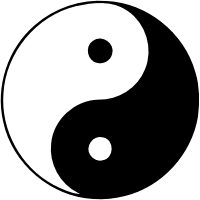
Honey and Onions is just a metaphor I borrowed from the Arabic that has its roots in antiquity (as early as 500 BCE, the Greek philosopher Heraclitus wrote about the unity of opposites). My own personal journey with the concept began in 1992 when I started studying taiji chuan, which has its philosophical basis in Taoism. Multiple readings of the classic Chinese text Tao te Ching helped me intellectually grasp the dynamics of yang and yin: they are not opposite energies but instead represent complementary forces in life, each one containing the seed of the other.
Around the same time, I began Jungian psychotherapy and read books by and about Swiss psychotherapist Carl Jung. One of the concepts Jung explored was the tension between opposites, and how tension is fundamental to life and living systems. Jung asserted that the psyche cannot truly resolve this tension by eliminating one extreme but instead, only by holding the opposites in tension, a third, transcendent function can emerge.
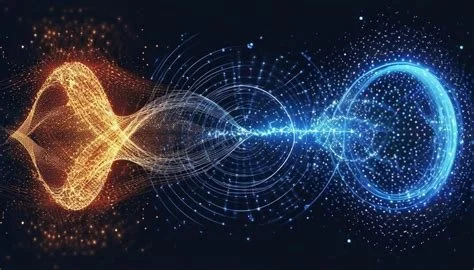
Years later, when I tried to grasp quantum physics, I discovered the intellectual framework of complementarity introduced by Danish physicist Neils Bohr. Experiments in quantum mechanics demonstrated that quantum objects (such as photons) display opposite properties; for instance, depending on the method of observation, light can be either a particle or a wave.
A grossly oversimplified example of how one observable phenomenon can have two seemingly opposite characteristics is seen in the renowned drawing by W. E. Hill entitled, My Wife and my Mother-in-Law:

Our Electric-Based Reality
We live in and are part of an electric Universe. Electricity is common both in the cosmos and within our bodies. I hypothesize that this electric-based reality is responsible for why we don’t tolerate ambiguity.
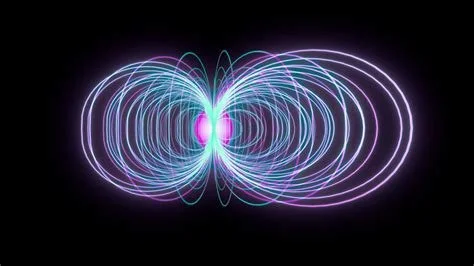
In the cosmos: Electric Universe Theory (or EUT) is a plausible (but not widely accepted) explanation of the structure of the cosmos. It states that electricity is omnipresent and it causes plasma to self-organize into wire-like structures, which in turn create magnetic fields. In EUT, electromagnetism is responsible for the structure of the observable Universe (in the standard model of Astronomy, the structure of the Universe is due purely to gravity). The geometry of spinning particles in magnetic fields is such that it always creates a field with a dipole (two-pole) structure – north and south. The poles are, technically, opposites, but, as part of the same field, complementary.
As in the cosmos, also on earth: The earth is a magnet of planetary proportions. The Earth’s molten iron outer core creates a magnetosphere, which extends into space, a natural force-field that protects us from solar radiation. Closer to the surface, a very weak electromagnetic field in the ionosphere creates the Schumann Resonances (named after physicist Winfried Otto Schumann). Both the amplitude and frequency of these resonances vary daily, even hourly, due primarily to the effects of solar storms on Earth’s ionosphere. The Schumann Resonances are the unseen electromagnetic mist through which we walk. Recent studies have corroborated the effect they have on human physiology.
In our bodies: We are electric, too. Each of our cells acts like a battery, creating an electrical charge from the potential difference that exists across our cell membranes. Oversimplifying (again), when our cells create an imbalance, sodium and potassium ions are “pumped” across the membrane, generating a current, which allows our body to function mechanically. This is the electrical trigger that causes muscles to contract and fire off nerve signals.
Nuance
The Universe has many attributes and our understanding of it is, without question, far from complete (hence the mystery). But I can’t help drawing the conclusion that if the core mechanism for how our bodies work is this relationship between charges, and we live on a planet brimming with electromagnetic energy, it makes sense that our electric reality affects how we think and make choices. The dynamics created by the relationship between opposites — a defining feature of the cosmos of which we are a part —must surely influence us. (I’m aware this is conjecture, but I’m standing by it.)
In our electric reality, I think the key yet overlooked action takes place not when the particles reach their poles but in the space between the extremes. Much like the yin-yang principle, it's the relationship between opposites that produces dynamics, with every point in that space having its own unique field strength and direction. The middle isn't empty or neutral in a passive sense; it's where the most complex interactions — its field geometry — exist. One can say that, as in an electromagnetic field, opposites require each other to exist at all. This active middle space creates a ubiquity of nuance.
Despite the abundance of nuance, the evidence suggests that we are “wired” (perhaps “vibed” is a better word) to gravitate to the poles. I think we are uncomfortable with the inherent tension between opposites because it’s unfinished. When John Coltrane or Jerry Garcia hit that middle sound in between the notes to create sonic tension, our very beings seek and expect a musical resolution. We may appreciate the sound, but we don’t like to hang out too long in the atonal ambiguity.
Dichotomies vs. Dualities
Being wired for the certainty of the poles and rejecting the dynamic space in between is not the only reason I think we are uncomfortable with nuance. The Cartesian, philosophically atomistic and wholly reductionist worldview that serves as our cosmological foundation certainly plays a role. In fact, it makes wrestling with opposites more difficult -- we break down the Universe into its parts, define and study how they work, and then build a library of rules, definitions, and intellectual dichotomies. Some distinctions are necessary (who prefers a cold shower over a hot one?) but others seem arbitrary and ideologically based (labor vs. capital, pro-choice vs. pro-life, Buckeyes versus Wolverines, etc.).
I believe we are more comfortable with dichotomies than with the dualities of complementary opposites because, intellectually and emotionally, the poles require less from us than what is required to understand and appreciate nuance. Salespeople, lobbyists, politicians and marketers are attuned to this and take advantage of our aversion to nuance, offering ideas and stories which play on our desire for certitude. In this context, understanding and appreciating nuance — the space in between — seems downright subversive.
The Tension of the Trek
The bike trek regularly doled out ample portions of complementarity every day. It was kind of like being inside an accordion – I was squeezed in both directions, swaying between the extremes. Hot and cold, sun and rain, headwind and tailwind, energized and exhausted – the only linearity of my experience was the west-to-east direction of geographical movement.
Getting squeezed by this accordion helped me notice the tension between opposites everywhere, starting with my own life. For example, the trek was a response to a long-held urge to ride across the country while voluntarily handcuffing myself to a corporate career that was antithetical to such an adventurous pursuit. Once on the ride, I continually struggled with the obvious tension between mind and body, the former willing the flesh to push through the pain, and the latter providing red-hot messages (think chafe) to simply stop.
Parallelly, the deeper I got into the trek the more obvious the internal contradictions of the USA became. One of the most visible ironies was how much poverty exists in what is one of the wealthiest countries on earth. I saw this glaring disparity comparing the economic dynamism on the coastal metro areas of Seattle and Washington, D.C. and the economic stagnation in much of the country’s interior.
Another irony I recognized was how our culture of convenience (with its warehouse-sized stores offering low prices for disposable products) leads to highly inconvenient economic outcomes, such as the collapse of small-town local businesses and the conjoined environmental and health crises from all that single-use plastic packaging. A third paradox took deeper digging to uncover: the oh-so American myth of rugged individualism, whose success was ironically predicated upon taxpayer-funded government infrastructure projects.
I want to be clear that I am not being critical of Americans as a whole or assigning blame to the average person for their difficulty to cut through the dream machine messaging. For one, I don’t think the Dreamland state is particularly unique to Americans. Different versions of this state exist in most societies around the world, especially in the industrialized nations. It’s just that in the USA, the influence of unfettered capitalism inflames our already wary discomfort with nuance and creates its own unique (and noxious) American Dreamland state.
What Can We Do About It?
The tension responsible for Dreamland is hiding in plain sight. It is the unquestioned status quo. Now, if the existing state of affairs were leading to positive social, economic, and emotional outcomes, then no questioning is required. But since we can all agree that improving our present circumstances is critical to our collective long-term survival, it’s time to start questioning things.
But who among us really has the luxury of time and energy to hold the tension of opposites and the patience to let the third, transcendent choice emerge? It takes a will of steel and weathered self-discipline to disengage from the plethora of nefarious distractions that, like sirens in Homer’s The Odyssey, beguile and enchant our overwhelmed spirits.
Sadly, life’s daily challenges reduce our desire and ability to observe the nuance and separate fact from fiction. Perhaps because of our struggles with this tension, we passively accept the stories we are fed as a condition for fulfilling the American trifecta: life, liberty, and the pursuit of happiness.
Spiritual traditions around the world have long offered a transcendent alternative to the tension between opposites present in the world. But the work required to do so is rigorous, and most people, struggling as they are just to keep their heads above water, don’t have the time and energy (or, some would say, the necessary devotion).
The opposite of dreaming is being awake, but I am not advocating for becoming “woke,” a term which some claim with hubristic moral certainty while others lob, like hand grenades, casually enflaming the culture wars.
I can only speak for myself.
Of all the tensions in my life, I think causing the most friction is the internal one between my conscious and unconscious mind. Like most, I assume the supremacy of the conscious mind, viewing it as crucial to make wise choices and navigate life smoothly. But as much as we value and require rational, deliberate thought (with a strong dose of objective scientific rigor), I find we also need to make room for what the unconscious mind proffers (or reject it at our own peril).
Our conscious selves are unconscious of some things most of the time (and of everything when we are in dreamless sleep). In contrast, the unconscious mind seems to be conscious of all things all of the time. It never sleeps.*
I strive to integrate the two – and find that third, transcendent way of being.
* from The Self-Aware Universe, by Amit Goswami, PhD