Tails I Win(d), Heads I Lose
Wind is one of the most enduring and powerful metaphors in human language and art. As an invisible, formidable and often fickle force, in ancient times it was seen as an instrument (or even a manifestation) of deities. In many languages, the word for wind is the same as spirit or breath (e.g., ruach in Hebrew, pneuma in Greek, prana in Sanskrit). Science dispenses with metaphor and reduces wind to a definition: the atmospheric circulation of air caused by the differential heating between the equator and the poles and the rotational force of our planet. The incontrovertible evidence of science is bounteous, but it lacks the compelling narrative expressed through metaphor.
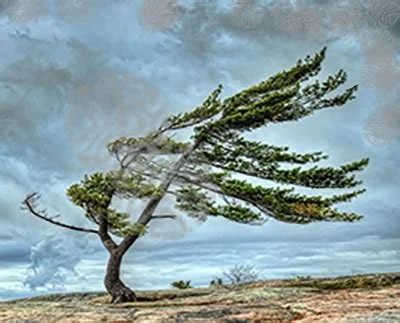
Wind, along with the terrain I would ride and the heat of the sun, was one of a trio of elements I faced each day on the trek. I could predict the other two: the sun’s radiance was a daily fact and using the Komoot app I could plot a visual representation of the next day’s elevation profile. But it was hard to know ahead of time how the winds would blow. A weather forecast only predicted the wind’s direction, but I discovered that wind, like politics, is local (particularly in the mountains, valleys, and canyons of the west). One day in Idaho’s Snake River Valley, a strong tailwind changed its mind and became a stubborn headwind within the space of one mile! I can’t tell you how disheartening the transition was – one minute I was enjoying honey’s sweet nectar; the next, my mouth burned with a bitter onion taste.
With Tailwinds All Things Are Possible
When riding a bike, your body is responsible for providing the force to achieve forward motion. You understand implicitly that physical exertion is required. Tailwinds, therefore, are an effort-diminishing gift, relieving you of the labor inherent in riding. Whether you are crossing the country or just going out for short, recreational jaunt in the neighborhood, when the wind is at your back riding is almost effortless. Tailwinds invariably stimulate the thought, “Heck, I could do this all day.”

As the days turned into weeks and I became progressively weaker, I was always hoping for a tailwind, not only to ameliorate my pain but to lighten the physical burden I had taken on. And when I reached the long, pancake-flat midwestern stretches of Illinois, Indiana, and Ohio and could no longer depend on downhills to provide a break for my legs, I ended up praying for a strong wind at my back. Unfortunately (paraphrasing the Winston Churchill quote about his father), at that point tailwinds were like God – busy elsewhere.
Tailwinds provided much-needed relief from the incredible daily grind. Like an addict, I craved a taste of a prevailing winds’ powerful hit that would erase the pain and, temporarily, make everything okay. While you probably can sympathize why I hungered so, I can tell you that this desire has its downside because I was building a trap for myself that I would inevitably fall into.
On Day 31, my second full day in Nebraska, I had almost reached the trek’s mileage midway point. I had crossed over from the hay and alfalfa fields of the western part of the state and, riding on US 20, entered the Sandhills, a mixed-grass prairie sitting on top of sand dunes (which itself sits on the Ogallala Aquifer). As I pedaled up and down the rolling hills beneath an unblinking sun, I left a trail of calories dissolving behind me until my tank got dangerously close to empty. At mile 57 I arrived in the small town of Merriman, where I met Joanie in the town’s park. I collapsed in the shade, munched on a sandwich and guzzled water. I still had 24 miles to reach our intended destination, the tiny town of Cody (where the welcome sign included the tag, “A town too tough to die”).
I left Merriman and turned east, and within a few minutes delightfully realized that the cycling Gods had blessed me with a generous tailwind. Soon I was gliding along as quickly as a stone skipping across a pond’s flat surface. I devoured the Sandhills, climbing the short western ramps like I was riding an e-bike and charging down the eastern slopes at 30 mph. It was the end of my fifth hour of riding in the scorching heat, yet I felt as strong as Hercules. I was under the influence of the tailwind drug. It acted like a stimulant, and it created in me a sense of power; much like Peter Parker after getting bit by the radioactive spider, I became giddy and thrilled with my ability to go superhumanly freaking fast with minimal effort. And like the tricks a drug plays on the mind, I somehow believed this ability was my birthright, that it should be like this all the time. I began to entertain thoughts of grandeur, because when you are zooming down the road at 25 mph, mysteriously, your muscles no longer ache, and you think surely that you will soon hit the shore and ride swiftly across the Atlantic to Europe without stopping. Yes, with tailwinds, all things are possible.

US 20 through the Nebraska Sandhills
I was so overjoyed with my speed, grateful for this atmospheric salve. Like an entertainment wrestler, it allowed me to get off the mats as the ref was counting to ten, take the fight to my opponent, and kick its ass. My pain and suffering vanished. I felt entitled to its assistance.
Headwinds Suck
Four days later, my drug turned on me.
On Day 35, I left the public park in O’Neill, Nebraska where we had camped and began the 75 mile-ride southeast towards the small city of Norfolk. I saw the wind lift the dirt from the park road and blow it straight into my face.
Uh oh.
I was still feeling the effects of a massage I had two days prior and in this weakened state it would be an understatement to say that I struggled. It was like I was fighting a relentless and unyielding force field. Seventeen miles later found me sprawled on a bench in the village of Ewing in a quasi-sleep state of depletion. My mind stumbled down strange pathways paved with exhaustion. I wondered if I would have to call it quits – trek over. Eventually, I decided that Ewing Nebraska was not a suitable place to end the trek. I mustered the energy and got back on the horse. Over time, I felt strength returning, but over those endless miles of suffering, I fell into the trap that my expectations had fashioned.
I still carried the privilege and expectation that tailwinds are like a catering service, providing all manner of flavors and tastes of relief. Even though I had voluntarily accepted the suffering, I was still holding on to a desire not to ache. Consequently, my physical suffering was topped with a greasy wad of mental anguish. Again, you can understand why I felt this way, but if I was going to reap the silver linings I also had to endure the dark clouds.
The day was interminable. The wind did not let up for even a single pedal stroke. After six and-a-half hours of pushing against my invisible foe, I entered Norfolk as the sun settled on the horizon. I was greeted unceremoniously by strip malls and long stretches of big box chain stores and franchises that dominate the United States: Menards, Walmart, Pizza Hut, Buffalo Wild Wings, Hampton Inn, McDonald’s, ad nauseum. Finally, I pulled into the parking lot of the hotel Joanie had booked at my insistence. I dismounted from Third Wind, stiff and spent. Flushed with equal parts exhaustion and emotion, I began to sob.