The Mystery of the Flat Front Tire
On the morning of Day 9, I emerged from Olympia onto the immaculately clean parking lot of the Walmart in Othello, Washington. Once again, the day promised to be blazingly hot, so I prepared quickly and methodically to beat the heat and start my pedaling by 7:30. But as soon as I pulled Third Wind (my Fuji touring bike) off the Olympia’s bike rack and placed it on the asphalt, I knew right away that I had a flat. As I rolled the bike towards the front of the vehicle I could hear the deflated front tire, like a tired child, whining, “I can’t do this again today!”
Flat tires on a bike trek are like minor speed bumps, especially when you have the luxury of a home base (Olympia, the Class B Motorhome we rented for the summer) with a floor pump. Thinking only of beating the heat, I quickly replaced the inner tube and hit the road. I still had an extra spare in my pannier. As I pushed off, I recall vaguely entertaining the thought that I should have dug out an extra innertube from the box locked away in a rear, external, compartment of the van and thrown it in the pannier. But I was pressed for time and didn’t think the extra effort was needed.
Ha-ha.
The plan was for Joanie to meet me somewhere along the way and finalize our destination, which would be governed by two factors – avoiding a route with poor air quality caused by the Asotin wildfire raging nearby, and finding a location with reliable WiFi so Joanie could connect and conduct her virtual performance the following morning.
East of Othello I crossed from heavily irrigated farmland (thanks to the Bureau of Reclamation’s Columbia River Basin project, a mid-20th century quasi-socialist engineering marvel) to the high desert where dryland farmers successfully coax about 70 bushels an acre of soft white wheat from the arid land. The sky was somber grey. In the distance I could see plumes of what looked like inverted tornadoes rising to the sky, heavy with dust, as harvesters combed the earth, literally separating the wheat from the chaff.
After 26 miles of pedaling, I stopped for a break where the southbound county road I was on intersected with Washington 26, which I would take east towards the village of Washtunca. The intersection was, of course, not designed for a resting bicyclist’s comfort. I managed to lean my bike against a flimsy, plastic reflector tab and sat on the rough graveled slope descending from the road, several feet above the empty field pocked with short, rough harvested stubble. As I sat, the rocks dug into my derriere.

When I began packing up to leave, I noticed the front tire was flat once more. “Onions again!” I thought to myself. Realizing this was no one-off fluke tire puncture, I needed to perform a close inspection of the tire and maybe even the wheel’s rim instead of just swapping out the flat with a good tube. But the exposed, rough intersection was not the ideal place for a patient, time-consuming examination; there was hardly any room between the slope and the asphalt to work comfortably. Worse, perhaps, was that there was no escape from the sun, which was now poking through the clouds. The most sober course of action would be to play the hand of caution and discomfort myself (even more than pedaling all day does) and locate the tiny foreign object I suspected was the source of my slow-leak troubles. But I wasn’t sober -- you could say I was drunk with the idea of forward progress. I took a calculated risk and used the last spare tube to get to Washtunca, 17 miles distant. I tried calling Joanie to set up a rendezvous but I had no cell reception. I did have a CO2 cartridge and adaptor with me, but I wanted to keep them in reserve in the event the tire’s slow leak required another quick boost of air.
I pushed off on my mostly inflated tire and rode cautiously across the high western plain, craning my head every now and then to see if the tire’s pressure was holding. Eventually, I reached the lip of the plateau and descended gleefully 500 feet into a deep, narrow valley where I found Washtunca, nestled at the northeast end of a dry coulee where glacial floodwaters once ran.
I rode down Main Street, a wide avenue bordered by mostly empty and boarded up shops. It was like riding into some large Hollywood studio lot set up as a deserted western town. There was a pervasive sense of abandonment. The only action on the street was a family of wild turkeys, wandering like a lost platoon. But I couldn't explore the old-west time capsule I had just discovered because right after I met the turkeys, I noticed the front tire’s leak was, as economists would say, increasing at an increasing rate, and I was getting dangerously close to riding on the rim.
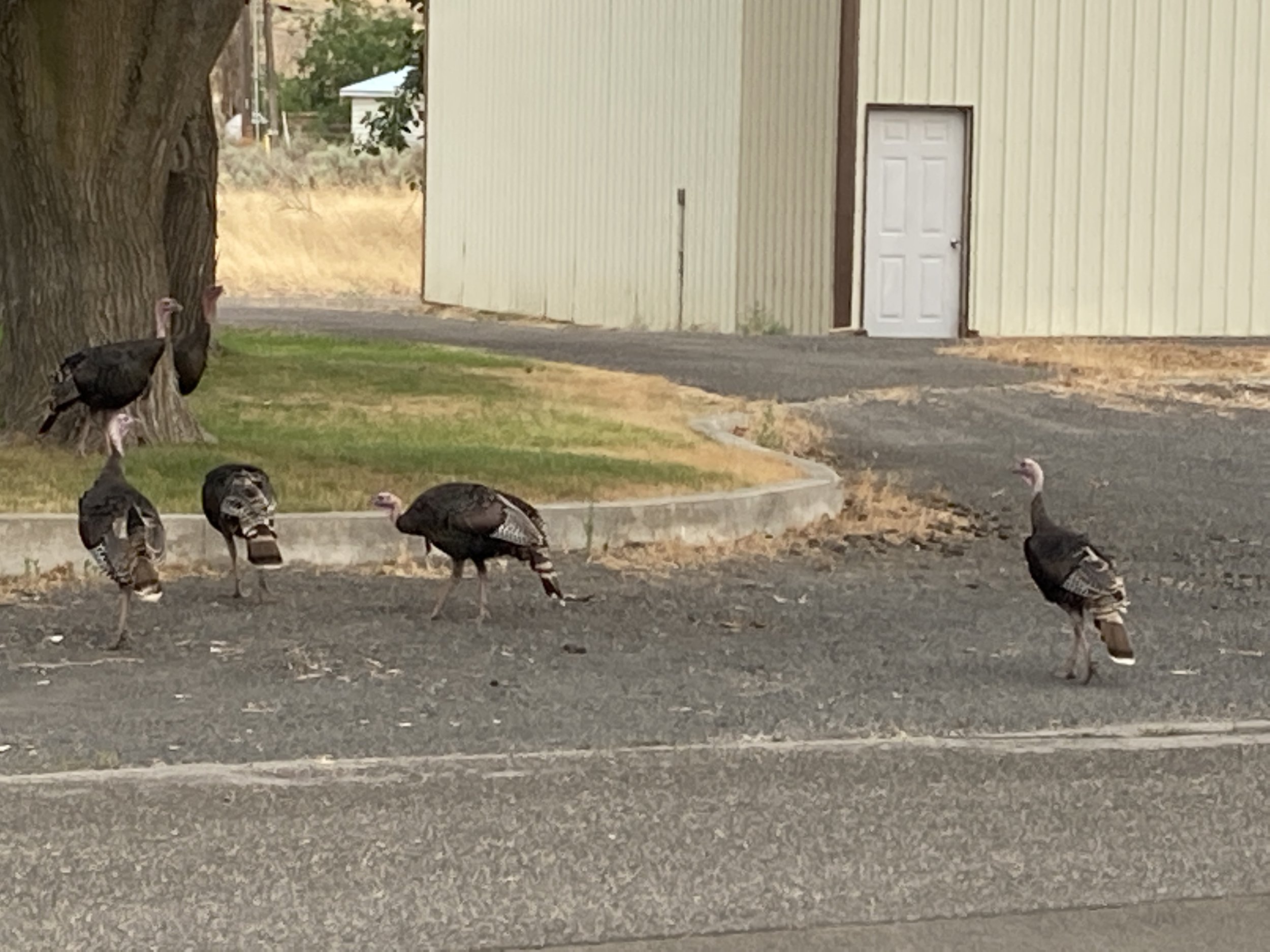
The only souls walking on Main St in Washtunca, Washington
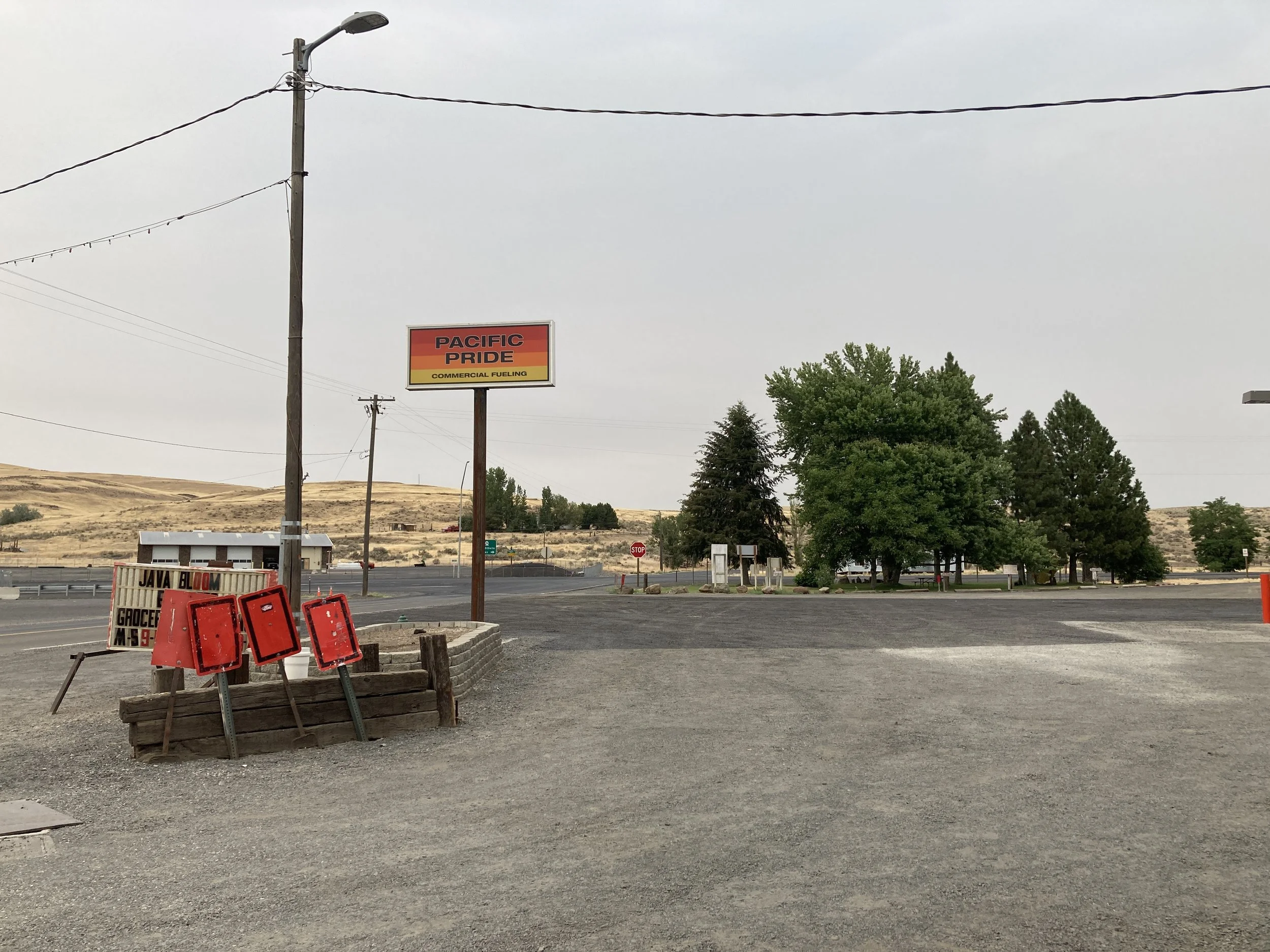
Now I was in true onions and liver territory: no spare tubes and only spotty cell coverage to coordinate with Joanie. I parked my bike next to the elevated porch next to the Java Bloom café facing the Pacific Pride gas pumps. There was a visual congruence to my location and predicament: My progress had come to a halt in a washed out town in a thin valley under ashen skies. After grabbing a cup of coffee, I sat down on the shaded porch to unravel the mystery that caused three inner tubes to puncture.
I removed the tire and tube from the wheel and began to closely inspect the tire, inside and out. I expected the culprit to be a tiny shard of glass embedded in the tire’s thinning tread, but the tire was free of glass (or metal).
This would be more challenging than I expected. Fortunately, I had plenty of time as I managed to get a text to Joanie, who wouldn’t get to Washtunca for at least another hour. I took a deep breath and restarted my inspection, focusing on the inside of tire, the woven nylon tire carcass (yes, that’s the official term). I pulled open the tire’s beads and rubbed my finger across any blemishes I spotted, but they were all smooth to the touch. “Caramba!” I thought to myself, “How can something so troublesome be so elusive?” I looked up and surveyed the wide gravel parking lot, eyes fixed on the faded landscape: the drab gravel, smoky bleak skies, and bare hills in the distance. Finding the cause of my flat was like looking for a pin in that uninspiring scene. Come on, Doug! Focus!
I returned to my task. Pull, inspect, swipe, repeat. Nothing.
Nothing again.
And again.
Something!
After who knows how many times swiping my finger across the tire’s carcass, I felt a barely perceptible sliver of resistance. I zoomed in (literally, as my nose was virtually inside the tire), and with my Swiss Army Knife tweezers, located and then extracted an insignificant looking splinter. I held it aloft. Was this microscopic-sized remnant of a remnant of a roadside thorn responsible for bringing the day’s progress to a standstill? If so, it was a humbling metaphor of how the immaterial can bring the most well-planned and formidable undertaking to a screeching halt.
Mystery solved. But this was no consolation.
I didn’t yet know that another tire mystery would arise in the near future, one that would shadow me most of the way across the country.