The Mystery of the Flat Rear Tire
As recounted in my post about The Mystery of the Flat Front Tire, a close inspection of my front tire promptly resolved the issue. On the next rest day, I purchased a pair of new Vittoria Randonneur touring tires to replace the threadbare ones I somehow neglected to replace before I left home. With squeaky clean synthetic rubber on both wheels, I felt secure that my tire woes were behind me.
But the physics of stress, load, and material fatigue would conspire to create a new mystery that, like a pesky sprite, annoyed me nearly all the way across the country. It plagued me with six rear tire flats, leaving me scratching my head for weeks until I met The Wizard.
It all began when I slipped out of the picturesque Sun Valley in Idaho on Day 19 onto the Snake River Plain, a crescent-shaped arid valley that stretches four hundred miles from Wyoming in the east to Oregon in the west. The plain is a stark, desolate, and beautiful landscape, blemished only by rough-looking towns along the valley’s edge where you can see a “Last gas for 50 miles” sign before heading into the sun-bleached landscape. I half expected to see a vulture perched on top, eyeing me hopefully with a mischievous smile.
My route that day took me through the Craters of the Moon National Monument, an alien-looking landscape of basalt spires and spatter cones scattered across a broad sagebrush steppe. I had just finished a lung-bursting 1,100-foot climb up to a higher lava field when I heard a troubling pssssshhhh sound. I looked down and saw my rear rim riding low to the ground. The flat tire peered back at me, shrugged its deflated shoulders, and said, “Sorry, dude, but you’re shit out of luck.”
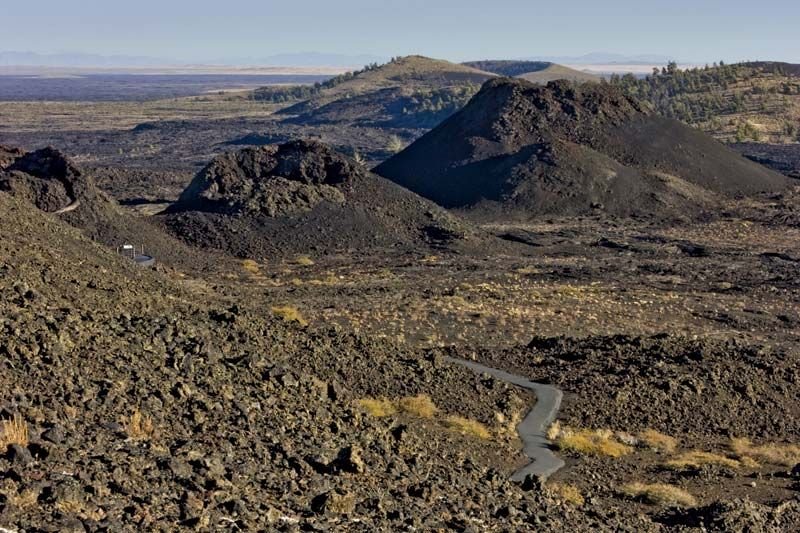
Basalt cones on the sagebrush steppe in the Craters of the Moon National Monument
In general, replacing a flat innertube is not an intrinsically difficult task once you have mastered it (which doesn’t take much), yet it’s far easier to do in the comfort of your home or shop with a bike stand and not on the side of the road in the high desert under the hot summer sun. And this would not be as easy as replacing a front wheel tube -- rear tire flats are a greater pain in the butt because they require negotiating the greasy chain and drive components.
I got to work. With my sturdy tire irons in hand, I struggled only minimally to unseat the tire’s bead from the rim and pry loose the flaccid tube. It’s always important to ascertain the location of the puncture, because if it’s on the road-facing side of the tube there’s a good chance that, like my front tire experience, a foreign object might be the cause, requiring me to inspect the tire for an embedded piece of glass or metal. But the puncture was on the rim side of the tube, close to the valve.
I heard a car stop behind me. I looked around to see a woman with styled, blown hair in a large Detroit sedan with Texas plates. “Do you need help?” she asked. She didn’t look like a bike mechanic, so I smiled appreciatively and told her I was fine.
Getting the rear wheel back on was a little trickier, but I managed the balancing act and was soon grunting as I worked the mini-pump, inflating the tire to a rideable pressure. Right as I finished, another vehicle stopped: a van with Bike Gallery markings on the side. Lo and behold, a veritable bike mechanic emerged and offered his help. “Where were you ten minutes ago?” I asked. But I did use his floor pump to get the tire fully inflated. “Good thing the chances of another flat are slim,” I thought to myself.
Cue the laughter of the Gods.
On Day 22, I woke up in Idaho’s Teton Valley under a deep blue sky and set about preparing for the challenging Teton pass I would have to climb later that morning. As I prepped Third Wind for the day’s ride, I noticed the rear tire was flat again. Since I had the floor pump at my disposal, I quickly made the swap, not before inflating the punctured tube to see where it had failed. Again, it was the same spot – close to the valve. But Teton Pass was calling, and I didn’t want to linger, so I made a mental note and tucked it away in a corner of a high shelf in the back of my mind.

Teton Valley, Idaho
Six days later, I was struggling up short, steep climbs in western Wyoming’s arid Wind River Valley on a day so hot that an ancient Egyptian would probably find the valley a suitable site for worshiping Ra. I was literally in the middle of nowhere when the rear tire gave out again – flat rear tire #3. Sure enough, the tube I had fitted on that cool Teton valley morning was punctured a few millimeters from the valve. There I was again, changing a tube at the side of the road under an unforgiving sun, hands full of grease, balancing the bike, gritting my teeth, and (finally) recognizing something fishy was going on with the rear wheel that had caused three flat tires in the space of six days.
We spent the night in Riverton, WY (which had not a single bike shop). Since I was about to traverse one of the driest and most remote portions of my route, the recurring flats forced me to change my plans. We drove southwest to Lander, a bicycle-friendly gem of a town with a well-appointed bike shop staffed by a congenial mechanic named Rusty. I was his only customer that morning and we triaged my tire and tube situation. Was it possible that there was a tiny, unseen rough spot on the wheel’s rim that, though unseen to the naked eye, was causing the trouble? I left the bike with him for the day for a more detailed inspection and to replace the rim strip while Joanie and I explored Lander and the surrounding area.
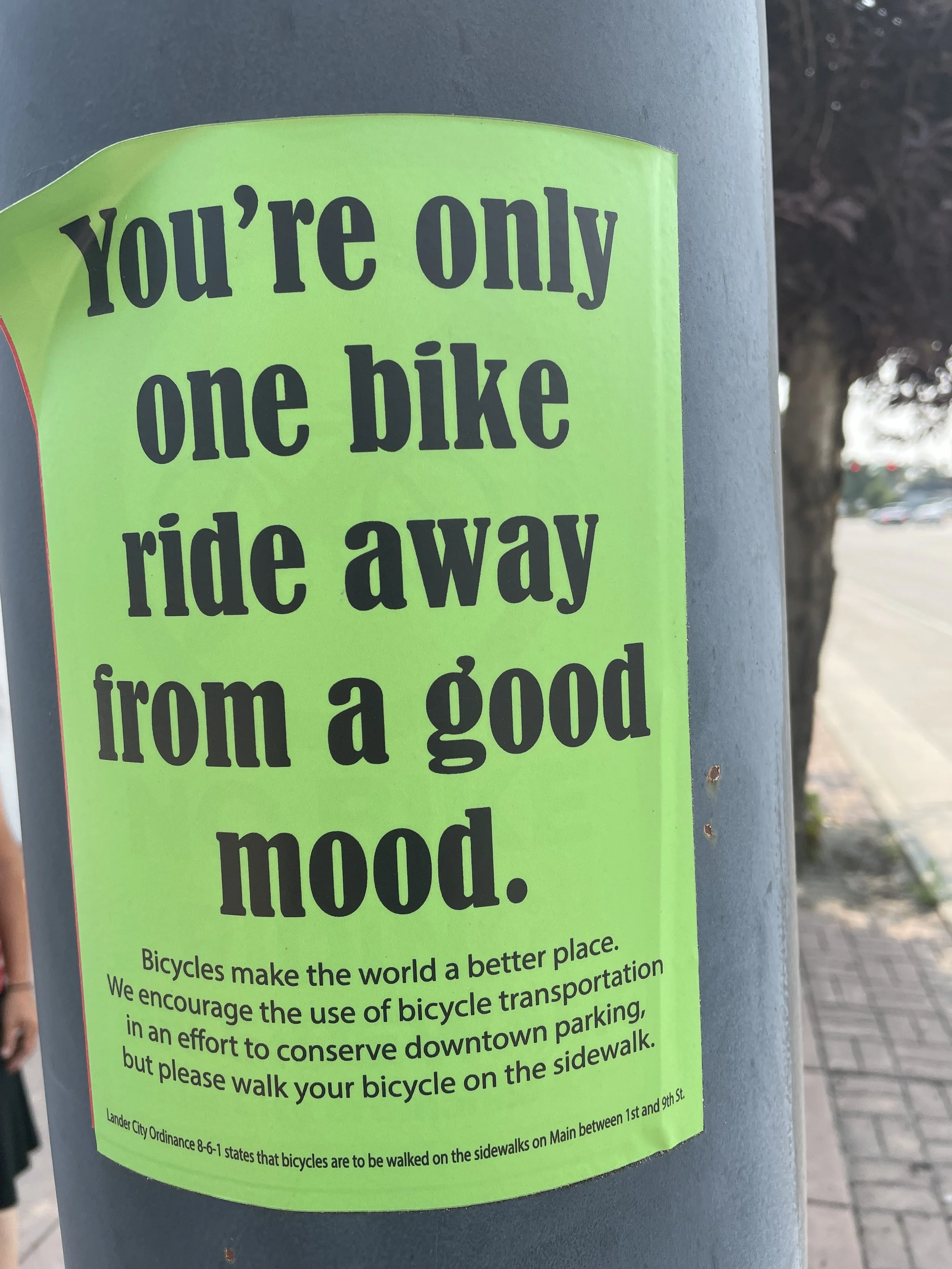
Why I liked Lander, Wyoming.
I returned later in the afternoon. Rusty had cleaned out the rim and replaced the rim tape but did not find any clear cause for the flats. We spent the night in a town park and the first thing I noticed in the early morning light was that the tire was flat again. What the flock?
Fortunately, Rusty opened the shop at 7:30. We both scratched our heads. Typically, bicycles don’t present many mechanical mysteries because they are relatively simple machines. There had to be a logical explanation for the flats; we just hadn’t discovered it yet. Since the punctures only began after I had purchased the new tires, we agreed it was worth a try to replace the rear tire.
And off I went. Over 750 miles rolled by with nary a flat. But late in the afternoon ten days later at an exposed intersection in western Iowa, I punctured for the fifth time -- in the exact same spot. The next morning I toyed with the wheel, even adding a layer of tape on the rim next to the valve opening, hoping to add some buffer to negate whatever was causing the tube to fail.
But nine days later when we woke up in the 4-H Fairgrounds in Pontiac, IL, the tire was flat for the sixth time. What should I do? One option was to simply stock up on inner tubes and expect a puncture every eight or nine days. But that was absurd, because a puncture can happen anywhere and even though it’s not a big deal to replace a tube, the hassle and thought that it could happen at an inopportune time (in a dangerous area or in the middle of a downpour) was not palatable. Instead, I decided to take the next logical step and fork out money to buy a new wheel at my next planned rest day in Lafayette, Indiana.
Which is where I met The Wizard.
Virtuous Cycles takes up the bottom floor of an old two-story house on a side street in downtown Lafayette. Its decidedly non-corporate vibe was sonically highlighted by the wild bebop music I heard upon entering the store. A slouched, tired-looking, bearded mechanic listened to my story and nodded. “I know what’s going on,” he said.
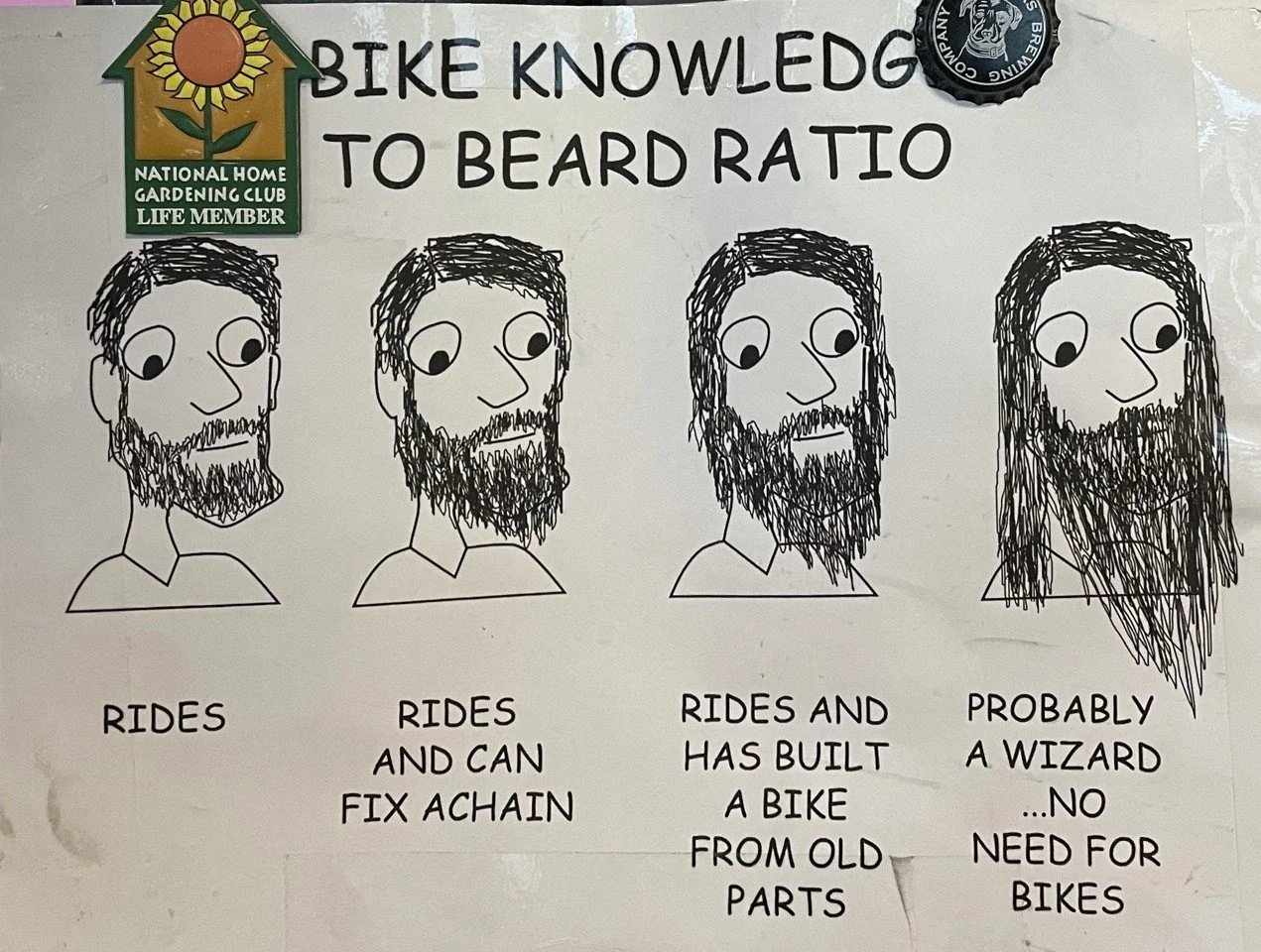
Homemade sign in a bike shop in Cumberland, MD.
Perhaps it was kismet, but I was talking to someone who once had this very same problem. He hypothesized that my rear wheel’s rim was not sufficiently wide enough to carry the load. I had forgotten that I was riding on a replacement wheel – the original trekking wheel was damaged irreparably years before in a Keystone Cops-variety crash involving me and Joanie. The newer wheel was the one suffering the recurring punctures. My new mechanic friend believed that the stress on the wheel increased tension on the tube, causing it to fail repeatedly at its weakest point – the point where the small, circular rubber section at the base of the valve joins the rest of the tube. I wasn’t so sure about that because, as I explained, I had done two fully loaded bike treks on that very same wheel, though I was willing to concede that neither trek was as long as the current adventure.
But he was right. I did not suffer another flat for the remaining 980 miles on my way to the Delaware shore. Mystery solved.
Is a wizard just someone with greater knowledge?